
Eseosa Imade
What is Answer Engine Optimization (AEO)? A Complete Guide for 2026
Artificial Intelligence has changed the search landscape.
In the past, traditional search was the focus of every business or brand that sought to be found online by their target customers. Now, there has been a slight shift, with Answer Engine Optimization (AEO) helping users find answers in seconds.
Is Search Engine Optimization (SEO) still important, and what role does AEO play in answering user queries?
The rise of generative AI tools like ChatGPT, Gemini, and Perplexity AI has undeniably impacted digital search. Users are more interested in conversational answers and direct responses than scrolling through links to find the right one. This has pushed brands to focus more on user intent while prioritizing creativity and relevance over keyword stuffing. A survey by Higher Visibility shows that 71.5% of people use AI tools for queries, with 14% using them daily.
In this article, I’ll cover the meaning of Answer Engine Optimization, how AEO differs from SEO, and how brands can use AEO to their advantage.
What is Answer Engine Optimization?
Answer Engine Optimization is the process of answering users' queries directly through structured and optimized content. AEO allows brands and businesses to appear in AI-powered tools such as chatbots, voice assistants, and answer engines like ChatGPT. For AEO, the focus is on user intent and providing a definitive answer to the user's specific question.
What is the Difference Between Answer Engine Optimization (AEO) and Search Engine Optimization (SEO)
AEO is focused on answering users in a conversational style and searching for the needed data directly. SEO is where search engines are focused on finding the right answers through relevant keywords and valuable content, including leveraging a website’s structure, content, user experience, and user engagement to find various answers to a user’s question. AEO and SEO are different in the following areas:
Goal
AEO provides a direct response to the specific question a user asks, while SEO is focused on improving the website's ranking and visibility in the search engine results page (SERPs).
AEO is focused on giving users the answers they need without further interaction with a website. In this aspect, the content is not focused on directing users to the website but rather on just answering the question.
For SEO, the aim is to show users a number of websites that might have the answers they’re seeking. The intention is for the users to click on those sites and read through to find the information. SEO is focused on the goal of improving a website's ranking position to drive organic traffic and attract visitors. This entails upgrading all aspects of the website, including the technical aspect and non-technical, so it can be found by search engines.
AEO, on the other hand, is focused on giving the users the answers they need without further interaction with a website. In this aspect, the content is not focused on directing users to the website but rather on just answering the question.
Specific Platforms
As the name implies, AEOs are answer engines that include AI chatbots, voice assistants, featured snippets, e.g., Google AI Overview, Knowledge Graph, etc. While SEO includes the traditional search engines like Google, Bing, Yahoo, etc.
Content Type & Structure
AEO optimized content is easily findable and crawled by AI assistants and bots, while SEO involves a more comprehensive content format and structure. For example, I took the traditional search approach and asked Google, “What is the best food in the world?” In response, I got different websites, including TasteAtlas, CNN, Hungry Voyagers, and others.
In contrast, when I asked the same question on an AEO platform like ChatGPT, I received a direct list of foods such as pizza, Massaman curry, sushi, and Peking duck. SEO highlights top-ranking websites that follow technical standards, while AEO delivers immediate answers.
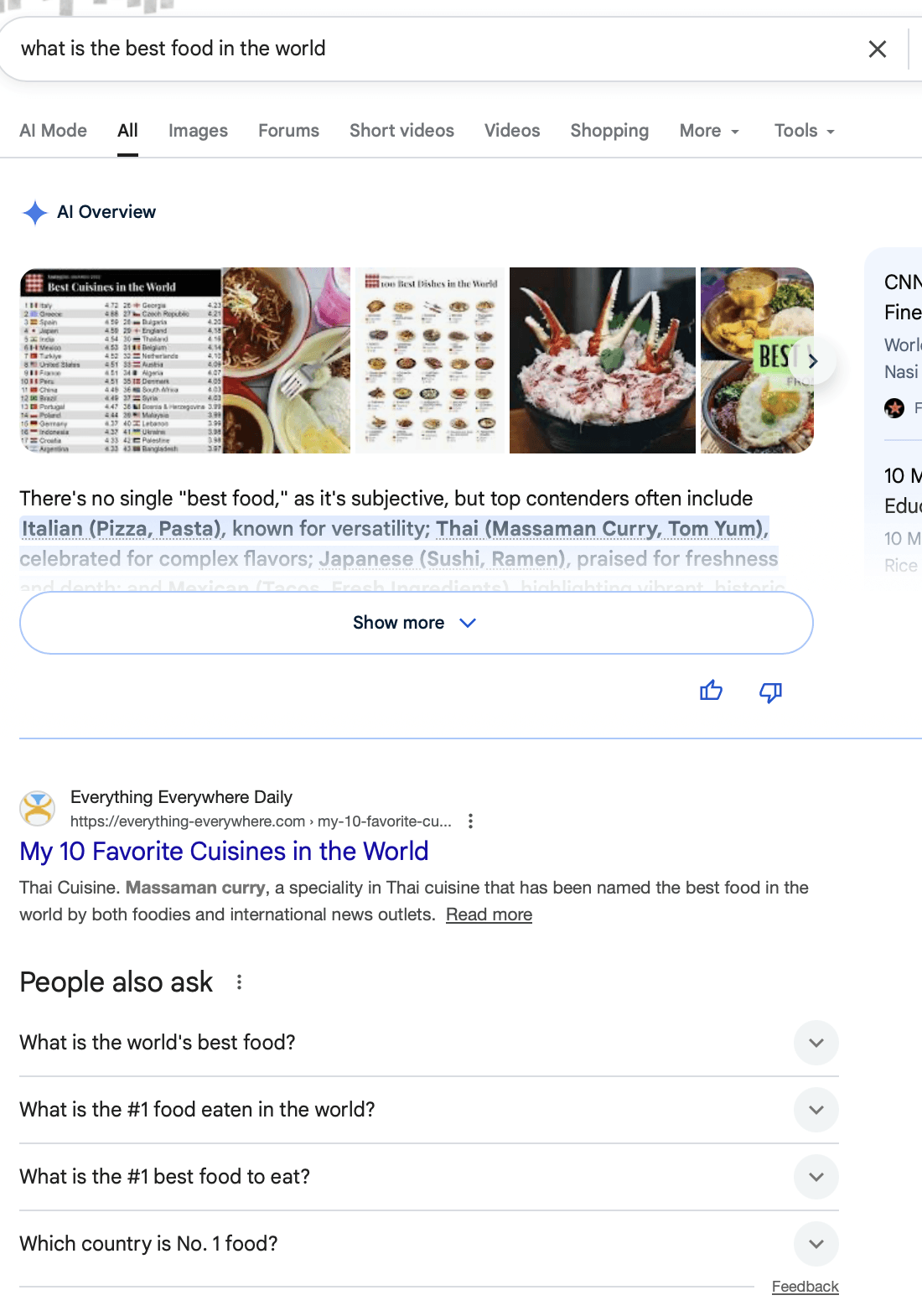
A snapshot of Google search results for the best food in the world
Query Format
A usual query for SEO search would include 2-3 keywords, but for AEO, it’s more conversational and can be long-tail in the natural way a person would typically speak.
Optimization Methods
AEO uses NLP (Natural Language Processing), a type of AI focused on generating human language and responses. SEO uses techniques such as backlinks, technical site structure, and website optimization
Despite their differences, AEO and SEO are very common and use the same principles in areas of quality of content, the user experience, and tactics such as targeting some key phrases from the users' questions or linking to reputable websites
Key Area | AEO | SEO |
|---|---|---|
Platforms | Uses answer engines such as Gemini, ChatGPT, Perplexity, and Microsoft Copilot | Uses search engines like Google, Bing, and DuckDuckGo |
Goal | Focused on providing a direct answer to the users’ queries | Aimed at increasing organic traffic and rankings |
Content Style | Geared towards answering the questions with facts and data in a concise form. Takes an answer-focused approach | Comprehensive content and data approach with target keywords that may not answer the query instantly |
User Engagement Format | Allows users to get an answer without clicking or going through links | Users have to click a link or read through various websites to get an answer |
Key Metrics | Focused on mentions, citations, referral traffic, and conversions | Focused on domain authority, website rankings, traffic, and conversions |
Technology | Uses Natural Language Processing | Focused on transitional search engines |
How Does AEO Work?
Understanding how AEO works is fundamental for developing content that meets your customers’ needs, especially if you want your brand to be found across all engines. Here’s how it works:
The use of Natural Language Processing (NLP):
NLP is the backbone of answer engines. It helps interpret the data, content, and intent behind a query. Instead of simply matching keywords, NLP understands the query and responds with a meaningful answer. For example, asking “What is the best food in the world?” could yield not only the top food but also details about where it originated and related follow-up information, rather than just a single response.
Reliance on Structured Data
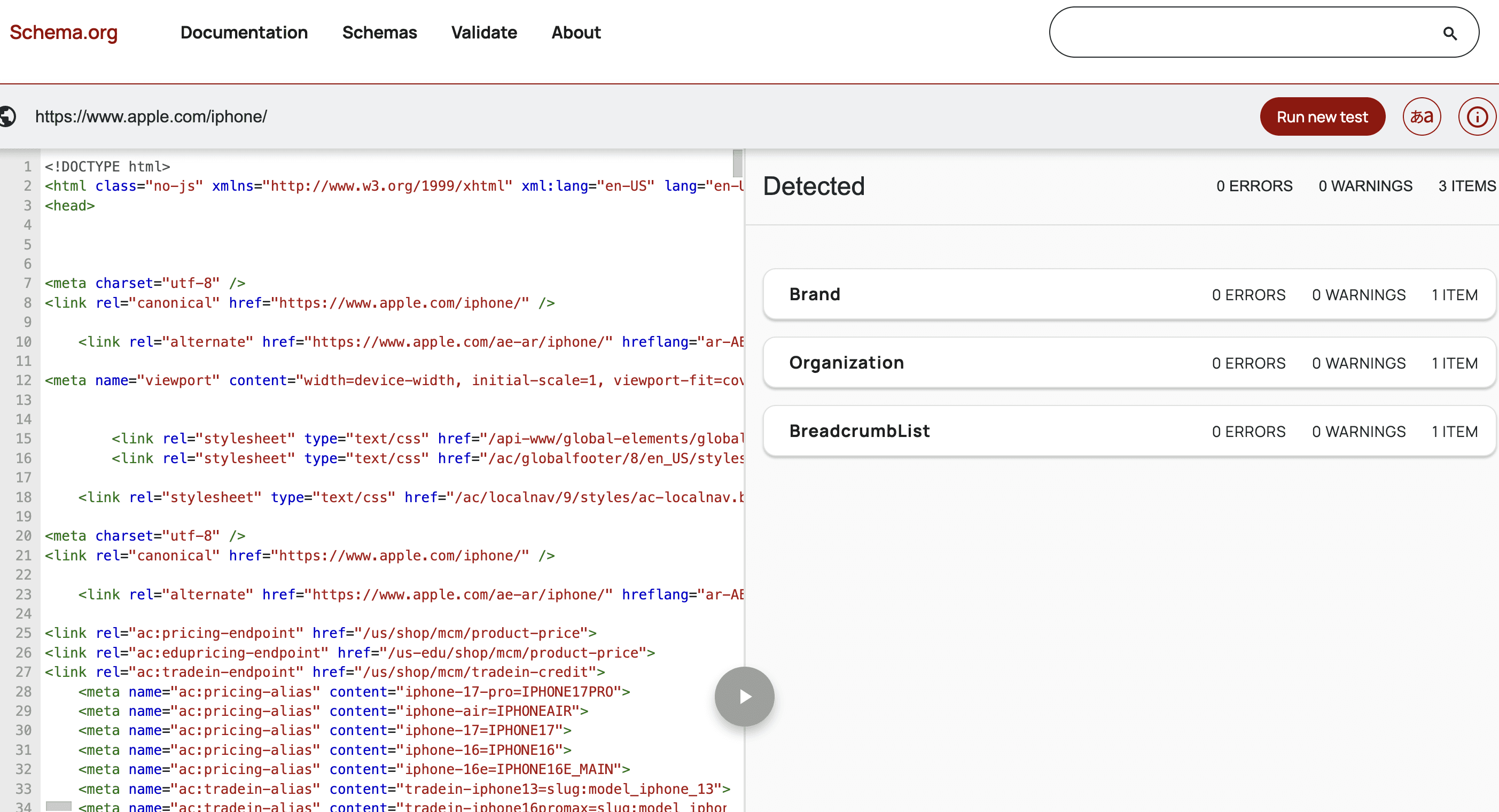
Structured data, like schema markup (e.g., using Schema.org), acts as a clear set of labels and relationships for web content. It helps AI engines to interpret the meaning and context of the information presented on a webpage, clarifying what the content is about and what specific details it offers.
Structured data acts as a bridge between human-readable content and machine understanding, enabling a more relevant and engaging user experience. For instance, Google’s Knowledge Graph connects facts from multiple sources, while schema markup makes it easier for AI engines to extract key details. In short, structured data enriches responses, boosts machine learning models, and ensures that users receive accurate and organized answers.
Also, for the AI engine to provide a specific and direct answer, structured data allows the engine to extract the relevant and key information from the webpages. It also enriches the search results and response. Structured data provides organized and labeled information to boost machine learning models that power these answer engines.
AI and Machine Learning
Answer engines use machine learning models that are trained on a variety of information and data sets. Search engines use models like ChatGPT, BERT, MUM, and DALL-E 3 to understand human questions. These models have been trained widely on different areas of the web to understand human language and provide factual information.
How Brands Can Use Answer Engine Optimization (AEO)
Businesses looking to grow and be found everywhere by their target audience should incorporate AEO into their content strategy. Keep in mind that SEO is still very relevant in today’s search landscape, and AEO is complementary.
Think in Questions
The first step is to frame your content around the questions your target audience is asking, not just keywords. This approach could increase conversion. Use different methods to help identify the kind of questions your audience may be seeking answers to, including:
Researching on forums such as Quora and Reddit
Using search tools such as Google’s “People Also Ask” boxes, Answer the Public, SEMrush topic research tool, etc.
Listening to your customers directly through customer calls, email conversations, or discovery calls
Focus on User Intent
Understanding the user intent, whether informational, navigational, commercial, or transactional.
Informational: Users want to learn more about a concept or find a specific answer (e.g., “What is the best food in the world?”)
Navigational: Users are searching for a specific website or page (e.g., “YouTube login”)
Commercial: Users want product or service information to compare options before buying (e.g., “best laptops under $1,000”)
Transactional: Users are ready to take action, such as purchasing a pizza or ordering an iPad.
Use Technical SEO and Schema Markup for AEO
Even with the changes, there are still common similarities between SEO and AEO, which is why some principles and practices that apply to SEO are still very helpful, specifically the structure and metadata. They include:
Having website visibility to ensure your website can be crawled by both search engines and answer engines
Use structured data (Schema.org), including an FAQs page, step-by-step guides, local business schema, speakable schema, and article schema.
Use questions in your metatags, such as the title tag and meta description
Use internal links to enhance website navigation, help search engines discover and understand your site's structure, and distribute authority across pages.
Provide updated, valuable content that answers questions upfront
Technical Authority Building & Off-page Presence
AEO involves gathering answers from everywhere, including off a website page. Therefore, there is a huge need to consider building credibility on your website. This includes:
Listing your business on major platforms to feed information to the engines about your business, and provide answers that customers may be seeking
Leverage organic growth by including customer testimonials and reviews. This shows the engines that you are credible and can be trusted, also a way to have more information beyond what you created
Like traditional searches, backlinks play a role in building trust and authority. Hence, having a well-structured backlink strategy will be helpful for AEO and SEO purposes.
Using Google’s E-E-A-T (Expertise, Experience, Authoritativeness, and Trustworthiness) formula to craft relevant content tailored for your target audience will help establish brand presence and thought leadership.
Measure, Test & Strategize
Understanding the exact answer your audience needs and helping the answer engines to find your brand would entail testing to know what works. This is going beyond keyword research, user experience, and other traditional methods you have used in the past. This time it will include you:
Constantly staying updated to see what’s new in the industry and how AI engines are processing this information
Tracking what people are searching for and monitoring if you pop up during their search experience using tools like Moz, Semrush, UberSuggest, and Ahrefs
Using different answer engines and gauging the responses to understand how they interpret the data. This could be searching on Google and interpreting the output from Google AI overviews, or learning from voice assistants and chatbots
AEO tools, such as OmniSEO, also play a huge role in helping brands understand their mentions across the different AI platforms that consumers use
Tracking conversions in different ways and understanding your traffic source using tools like Google Analytics 4
Conclusion
The era of searching exclusively on Google is fading. Today, users turn to multiple platforms, social media channels like TikTok and Instagram, traditional engines like Google and Bing, and AI-driven tools like ChatGPT. Businesses must adapt by revisiting their content strategies and tailoring them for AI engines to stay visible. By embracing AEO, brands can become credible, moving beyond keywords and focusing more on valuable responses that meet the customer's intention.